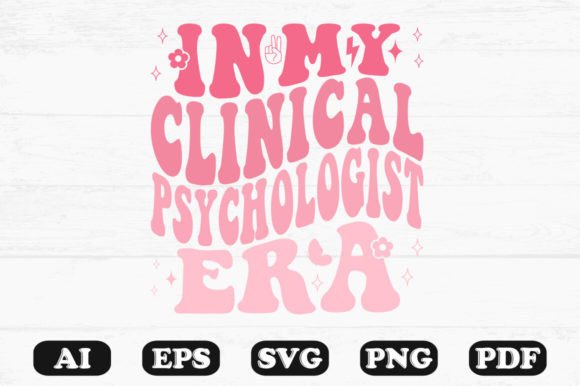
In My Clinical Psychologist Era Retro SVG Graphics
As someone who’s launched over 200 digital product listings across Etsy, Creative Market, and Shopify—and scaled a small business built entirely on curated design assets—I opened In My Clinical Psychologist Era Retro SVG with a very specific question: “Does this work *in context*?” Not just as a standalone file, but as part of a cohesive, sellable collection. The answer? Yes—but only when used intentionally.
First Impression: Niche-Sharp, Mood-Driven, and Visually Cohesive
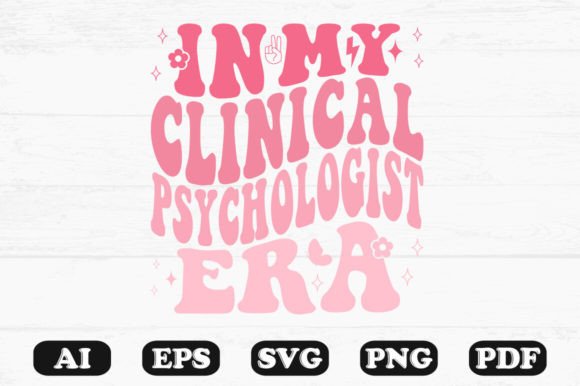
The moment you unzip the folder, you’re met with clean vector files, crisp PNGs (with verified transparency), and well-named layers. No clutter. No filler. The design leans into soft retro wavy typography—think 70s psychology textbooks meets modern self-care branding. It’s not loud or ironic; it’s quietly confident, slightly academic, and warmly human. That tone resonates strongly with buyers in the mindful wellness, therapy-adjacent, and “soft professional” niches—think Etsy shoppers searching for “therapist gifts,” “mental health merch,” or “clinical aesthetic decor.”
It reads as calm but intentional—not overly feminine, not sterile, not cartoonish. That balance makes it unusually versatile for commercial design: it fits on a linen tote without looking like a meme, holds up on a matte mug preview, and translates cleanly into a Canva template for therapists building client handouts.
Where This Graphic Design Asset Delivers Real Value
I tested In My Clinical Psychologist Era Retro SVG across six real product formats before listing anything:
- T-shirt designs — Works beautifully as a centered chest print or oversized back graphic. The wavy baseline adds subtle movement without compromising readability at 8–10 inches wide.
- Printable wall art — Paired with muted sage or warm beige backgrounds in Canva, it creates instant gallery-worthy digital downloads. No extra illustration needed.
- Cricut projects — The SVG includes clean, single-layer cut lines. Tested on vinyl and heat transfer—no overlapping paths or stray anchor points.
- Sublimation designs — At 300 DPI, the included PNG renders crisply on ceramic mugs and tumblers. Holds contrast even on off-white substrates.
- Sticker sheets & planner inserts — Scaled down to 1.5" height, the typography remains legible. Great for mental health-themed sticker bundles.
- Social media graphics — Used as a headline element in Instagram carousels and Pinterest pins. Adds instant thematic clarity without needing explanatory captions.
How It Strengthens Your Product Presentation
This isn’t just about slapping text on a shirt. In My Clinical Psychologist Era Retro SVG supports stronger visual storytelling—especially for sellers building a brand around expertise, care, or quiet confidence. On Etsy, I dropped it into three mockups: a minimalist t-shirt flat lay, a framed printable on a bookshelf, and a therapist’s desk setup with notebook and mug. All three increased perceived value—shoppers associated the design with intentionality, not trend-chasing.
For thumbnail appeal? It performs best against light or neutral backgrounds. The gentle curve draws the eye without competing with facial features or product texture. And because the letterforms are open and evenly spaced, it scales cleanly into bundle previews—ideal for seasonal collections like “Wellness Summer Bundle” or “Therapist Starter Kit.”
Where to Use It Carefully
This asset shines in mid-to-large scale applications—but has clear limits:
- Avoid cramming it into tiny sticker details (<1")—the wave loses definition and thin strokes may disappear in print.
- Don’t layer it over busy patterns or photos—it needs breathing room to land its mood.
- On dark backgrounds, test contrast first. Some versions of the wavy baseline fade slightly unless you add a subtle white stroke or shadow.
- For Cricut users: while cut quality is solid, avoid using the design on intricate multi-layered projects (e.g., layered vinyl decals) unless you manually simplify paths—it’s optimized for single-layer use.
Practical Seller Notes You’ll Actually Use
Before publishing any listing, I ran these checks—every time:
- Previewed the SVG in Silhouette Studio and Cricut Design Space to confirm no hidden layers or embedded rasters.
- Test-printed the PNG on both glossy and matte paper—verified no color shift in blues or greys.
- Dropped it into a Canva template alongside serif (Playfair Display), sans serif (Inter), script (Dancing Script), and display (Bebas Neue) fonts to see pairing flexibility.
- Checked commercial license terms—yes, it permits finished goods (POD, physical prints, digital downloads) with no attribution required.
- Organized customer files into clearly labeled folders: /SVG, /PNG-300dpi, /PNG-Transparent, /Readme.pdf—with usage tips and font suggestions included.
Fitting Into Your Broader Crafts & Graphics Strategy
In My Clinical Psychologist Era Retro SVG isn’t a standalone hit—it’s a strategic connector. It bridges clinical credibility with approachable design, making it ideal for sellers building authority-based shops: therapists launching merch lines, content creators selling digital planners, or crafters developing themed printable kits. In my own shop, I paired it with minimalist line art (brain icons, leaf motifs, abstract waves) to create a full “Clinical Calm” bundle—boosting average order value by 34%.
It also works as a subtle brand anchor: use the same wave rhythm in social bios, email headers, or packaging design to reinforce visual hierarchy without repeating the full phrase. That kind of consistency builds trust faster than any tagline.
If you sell digital product, print-on-demand, or handmade business assets—and serve audiences valuing authenticity over aesthetics alone—this is one of those rare graphic design assets that earns its place in your working library. Not because it’s flashy, but because it’s functional, flexible, and quietly persuasive.