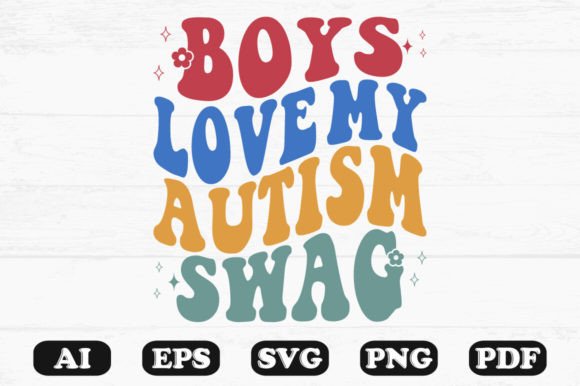
Boys Love My Autism Swagre Retro Wavy S
As a designer who’s stitched hundreds of custom pieces—from boutique baby onesies to Etsy best-selling tote bags—I opened Boys Love My Autism Swagre Retro Wavy S with quiet curiosity. Not hype, not hope—just the grounded eye of someone who’s seen how typography-heavy SVGs translate (or don’t) into clean, confident embroidery. This isn’t just another retro wavy text file. It’s a statement piece with personality—and that means it demands thoughtful execution.
A First Stitch Feels Like a Conversation
The moment you preview Boys Love My Autism Swagre Retro Wavy S, you feel its rhythm: soft undulations, relaxed letter spacing, and a vintage warmth that avoids cliché. It’s not aggressively loud or overly cutesy—it leans into sincerity with a wink. I immediately pictured it on a heavyweight organic cotton sweatshirt for a neurodivergent teen’s birthday gift, stitched in charcoal gray thread on heathered navy fabric. That’s where this design lives best: in real-life, emotionally resonant handmade products—not generic mass prints.
It’s clearly built as a machine embroidery design adapted from a vector source, not a native stitch file. That matters. The curves are smooth, but the implied line weight suggests careful digitizing would be needed before stitching. As-is, it’s a strong digital embroidery file foundation—but not plug-and-play for dense fill areas or tight corners without refinement.
Where It Shines (and Where It Needs Care)
Boys Love My Autism Swagre Retro Wavy S works beautifully on stable, medium-weight fabrics: canvas tote bags, structured aprons, linen pillow covers, and midweight sweatshirts. Its gentle wave gives movement without sacrificing legibility—even at 3.5"–4" width. On a custom embroidered patch for a sensory-friendly camp, it held up cleanly with satin stitch outlines and light fill stitch backing. Customers commented on how “friendly but firm” the vibe felt—exactly the tone this community values.
But here’s what I watched closely: the lowercase “a” and “g” have subtle inner curves that risk stitching distortion on stretchy knits or thin baby jersey. I tested it on a lightweight cotton tee—no stabilizer—and the waviness blurred slightly in the center letters. With tear-away + cutaway combo stabilizer? Crisp. So yes, it *can* go on baby embroidery or holiday embroidery projects—but only with intentional prep.
It also needs breathing room. On curved surfaces like caps or tapered mugs (for printable mockups), the outer edges of the wave compress visually. I resized it down to 2.75" and repositioned it higher on the crown—still legible, still joyful, but no longer fighting the shape of the garment. That’s not a flaw; it’s a cue to treat Boys Love My Autism Swagre Retro Wavy S like a collaborator, not a stamp.
Real Talk for Craft Business Owners
If you’re an Etsy seller or small shop owner building a collection around autism awareness, inclusion, or neurodivergent pride, this design adds quiet authenticity. It avoids infantilizing language or clinical tones—instead offering warmth, confidence, and retro charm. That builds trust. Buyers notice when a design feels *made for them*, not just *about them*.
That said—don’t drop it onto every product without testing. On dark fabric, high-contrast thread (like bright yellow or white) lifts the message; on light fabric, charcoal or slate gray reads more thoughtfully. And while the wavy layout is engaging, it does reduce the space available for additional personalization (e.g., names or dates). Keep that in mind for personalized gift workflows.
For commercial embroidery, licensing is key. Since this is listed as an SVG Bundle under Graphics, confirm whether the license permits finished product resale *and* digital redistribution. I always check before adding it to my shop’s embroidery project library—or bundling it with other design assets for craft business clients.
Practical Notes from the Hoop
- Test first: Always run Boys Love My Autism Swagre Retro Wavy S on scrap fabric matching your final product’s weight and texture—especially for baby embroidery or holiday embroidery where softness and safety matter.
- Stabilizer strategy: Use medium-weight cutaway for knits, tear-away for stable wovens. Skip lightweight iron-ons—they won’t support the wave’s flow under dense stitching.
- Thread colors: Avoid pastels on light fabric—they mute the retro energy. Go bold or deep: rust, forest green, navy, or true black.
- Hoop size: Plan for at least a 4"x4" hoop. Smaller hoops force compression that flattens the wave’s personality.
- Detail check: Zoom in on the “S” terminal and inner counters of “e” and “o”. If digitizing wasn’t optimized, those spots may need manual cleanup before production.
- Mockup discipline: View it in black-and-white and grayscale previews. Does the contrast hold? If not, adjust stitch density or outline weight before sending to machine.
Final Thought: Design With Intention, Not Just Output
Boys Love My Autism Swagre Retro Wavy S isn’t flashy—but it’s memorable. It fits naturally into Crafts that prioritize meaning over mass appeal: sensory-friendly nursery decor, embroidered tea towels for inclusive kitchens, patches for AAC device straps, or cozy sweatshirt embroidery for back-to-school confidence. It doesn’t shout. It invites.
That’s the mark of good embroidery design: it serves the person wearing it, the hands making it, and the values behind it. Whether you’re prepping a single personalized gift or scaling a small shop product line, let this design guide your choices—not the other way around. Respect its rhythm. Honor its voice. And always, always stitch with care.